
Search Engine Optimization: How a Website Gets Discovered on Google
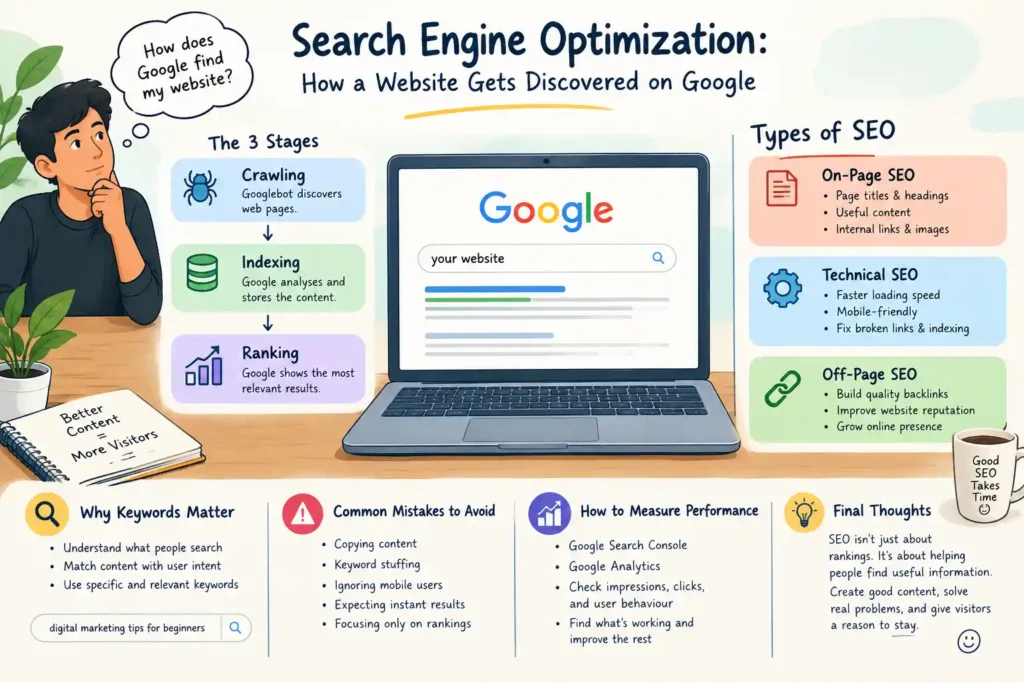
Have you ever wondered why some websites appear on the first page of Google while others are difficult to find? I used to think that creating a website and publishing content was enough to attract visitors. But there is more to it. A website needs to be easy for both people and search engines to understand. This is where Search Engine Optimization, commonly known as SEO, becomes important.
What Is Search Engine Optimization?
SEO is the process of improving a website so that people can find it more easily through search engines like Google. It involves creating useful content, choosing relevant keywords, improving website performance, and making pages easier for search engines to understand.
For example, imagine someone wants to learn about digital marketing. They might search for “digital marketing tips for beginners” on Google. If a website has helpful content related to that topic and follows good SEO practices, its page may appear in the search results.
SEO does not guarantee the first position on Google. Instead, it helps a website improve its chances of reaching the right audience.
How Does Google Find a Website?
Before a website can appear in Google search results, Google needs to discover and understand its pages. This process mainly involves three steps: crawling, indexing, and ranking.
1. Crawling
Crawling is the process of discovering web pages. Google uses automated programs called crawlers or Googlebot to visit pages and follow links to discover other content.
For example, when a new blog post is published and linked from another page, Google may discover it by following that link. A website can also use an XML sitemap to help Google find important pages.
2. Indexing
After discovering a page, Google tries to understand its content and decide whether it should be included in its search index.
Indexing is similar to organising information in a large library. When someone searches for a topic, Google can use its index to find relevant pages.
However, not every page that Google crawls will be indexed. Technical problems, duplicate content, and other factors can affect whether a page appears in the index.
3. Ranking
Ranking is the process of deciding the order in which eligible pages appear for a particular search.
Google considers many signals, including how relevant the content is to the search, its usefulness, and aspects of the page experience. There is no single trick that guarantees a top position.
A website that provides clear answers and genuinely helps its visitors has a better foundation for SEO than one that simply repeats keywords.
Why Are Keywords Important in SEO?
Keywords are the words and phrases people type into search engines when looking for information, products, or services.
Understanding these searches helps website owners create content that matches what people actually want to know.
For example, someone who runs an online gift shop might target phrases such as “personalised birthday gifts” or “unique gifts for friends.” These phrases are more specific than a broad term like “gifts.”
Keyword research helps identify relevant search terms, understand user intent, and plan content around real questions.
However, adding the same keyword repeatedly does not automatically improve rankings. Keywords should fit naturally into the title, headings, and content wherever they make sense.
The Main Types of SEO
SEO involves several areas of work. Each one helps improve a different part of a website’s search performance.
On-Page SEO
On-page SEO focuses on the content and elements within a web page.
Some important practices include:
Writing clear page titles and headings.
Creating useful, original content.
Using relevant keywords naturally.
Adding descriptive alt text to meaningful images.
Linking to other relevant pages on the same website.
The main goal is to make the page useful to readers and easy to understand.
Technical SEO
Technical SEO focuses on how well search engines can access and understand a website.
This includes improving website loading speed, making pages mobile-friendly, fixing broken links, using HTTPS, and checking whether important pages can be crawled and indexed.
A website may contain excellent content, but technical issues can still prevent some pages from performing well in search results.
Off-Page SEO
Off-page SEO involves activities outside a website that can help build its reputation and visibility.
One example is earning backlinks from relevant, trustworthy websites. A backlink is a link from another website to yours.
Good backlinks can help search engines discover pages and may contribute to how they evaluate a website’s authority. However, buying links or creating large numbers of artificial links can create problems rather than long-term benefits.
Common SEO Mistakes Beginners Should Avoid
When starting with SEO, it is easy to focus too much on rankings and forget about the people visiting the website.
Some common mistakes include publishing copied content, using keywords unnaturally, ignoring mobile users, forgetting to improve page titles, and expecting immediate results.
SEO usually takes time. Results depend on factors such as competition, website history, content quality, and technical condition. Regularly publishing helpful content and improving existing pages is often more useful than constantly searching for shortcuts.
How Can We Measure SEO Performance?
SEO is not just about getting a website to appear on Google. It is also about understanding whether the website is reaching the right people.
Google Search Console is a useful free tool for checking how a website performs in Google Search. It provides information about search queries, impressions, clicks, and average position.
Google Analytics can help website owners understand what visitors do after reaching the site, such as which pages they view and whether they complete important actions.
By reviewing this information, website owners can identify what is working and where improvements may be needed.
Conclusion
Search Engine Optimization is an important part of building a website that people can discover online. It combines useful content, keyword research, technical improvements, and a better experience for visitors.
There is no guaranteed shortcut to the top of Google. Search engines change, competition grows, and different searches require different kinds of answers.
For anyone learning digital marketing, understanding SEO is a valuable starting point. Instead of focusing only on rankings, the real goal should be to create a website that answers people’s questions, offers genuine value, and gives visitors a reason to stay.
Over time, that approach can help build a stronger online presence.